
You have no items in your shopping cart.

Choosing the right Stained Glass Tile Sheets requires more than comparing colors, patterns, and online prices. Manufacturers differ in glass thickness, mesh backing, edge finishing, color stability, and production consistency. These details become visible under bathroom lighting or across a sunlit kitchen backsplash.
Industry data supports this growing design interest. Grand View Research identifies renovation activity, decorative surfaces, and demand for sustainable materials as important drivers in the global tiles sector. Mordor Intelligence also highlights residential remodeling and premium interior finishes as continuing market influences. However, most reports group stained glass products with broader glass or ceramic tile categories. That limitation matters. Market figures should guide research, not replace product testing.
Tile-industry expert Bart Bettiga offers practical advice: “The quality of the installation is just as important as the quality of the tile.” His point is easy to overlook. A beautiful sheet can still fail when its mesh is uneven, its cuts are brittle, or the adhesive is poorly matched. Installation conditions matter.
This article reviews China’s top 10 Stained Glass Tile Sheets manufacturers through a practical lens. It considers factory experience, customization capacity, quality systems, export reliability, design range, and after-sales communication. Product samples deserve attention. So do technical datasheets and test reports. No ranking is perfectly objective. Supplier strengths can change with materials, equipment, and management. Buyers should verify current certifications, batch consistency, packaging protection, and project references before placing a large order.
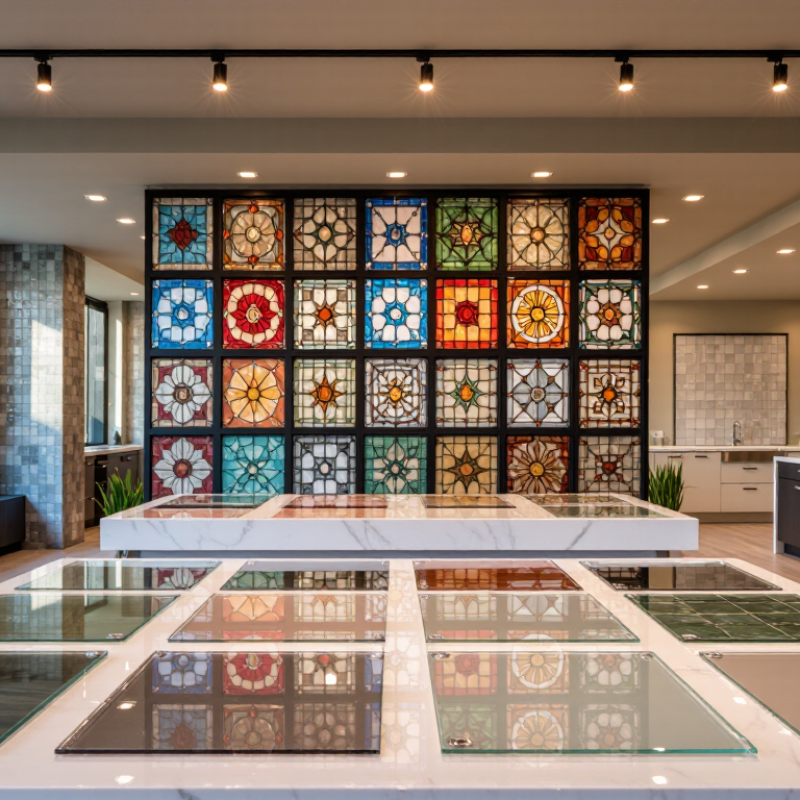
China’s stained glass tile sheet sector is often judged by appearance, yet laboratory evidence matters more. ISO 10545 provides the core testing language for ceramic tile performance. ISO 10545-3 measures water absorption and apparent porosity. ISO 10545-4 measures breaking strength and modulus of rupture. ISO 10545-9 examines thermal shock resistance. These figures help buyers compare factories beyond color and surface gloss.
Glass mosaics require extra care. ISO 10545 was written mainly for ceramic tiles, while ASTM C1026 directly addresses ceramic and glass tile freeze-thaw cycling. The method commonly uses 50 freeze-thaw cycles, exposing weak edges, poor bonding, or hidden cracks.
A sheet that survives the first cycle may still fail near the fiftieth.
Small details matter. Grout gaps matter too.
Industry reports from China’s building-materials sector continue to identify yield rate, export inspection, and energy consumption as important factory indicators. Customs statistics also classify many glass mosaic products under HS 7016, although classification can blur differences between architectural and decorative glass. Buyers should request batch-level test records, not only catalog claims. A clean report can still hide inconsistent backing mesh. Even ISO-aligned testing may miss installation mistakes, uneven substrates, and harsh local winters. That limitation deserves attention when comparing China’s top stained glass tile sheet manufacturers.
Choosing among China’s top stained glass tile sheet manufacturers requires more than comparing photographs. Sheet size affects cutting waste, installation speed, and shipping protection. Common formats include 300 × 300 mm and 327 × 327 mm sheets, but actual measurements can vary slightly. Request five random sheets from one production batch. Measure them yourself.
Request five random sheets from one production batch. Measure them yourself.
Joint tolerance deserves careful attention. Uneven mesh placement can create visible waves across a backsplash or shower wall. Ask for the permitted deviation in millimeters, not vague terms such as “high precision.” Water absorption is equally important in wet areas. Review laboratory data, test methods, and batch records. Lower absorption usually supports better durability, though adhesive selection still matters. Do not trust one sample alone.
Tips: Confirm MOQ before requesting custom colors or sheet sizes. A low MOQ may hide higher unit costs or limited production choices. Ask whether the quoted MOQ applies per color, pattern, or total order. Also check edge protection, carton strength, and replacement procedures. Photos can miss chipped corners. They often do.
An experienced buyer should compare three samples under daylight and warm indoor lighting. Color differences become obvious.
Record every measurement. Even careful evaluations can overlook mesh adhesion or small glaze defects. That is why a pre-shipment inspection remains worthwhile. Supplier claims are useful, but physical evidence is stronger.
China Top 10 Stained Glass Tile Sheets Manufacturers?
Selecting the top 10 Chinese stained glass tile sheet manufacturers requires more than catalog research. Verified capabilities should include factory audits, production records, and consistent sample results. Buyers should inspect glass thickness, mesh backing, adhesive coverage, and color stability. These details affect installation quality.
A reliable evaluation also checks monthly capacity, inspection procedures, packaging strength, and export experience. Request recent test reports for water absorption, thermal resistance, and surface durability. Review dated production photos or arrange an independent factory visit. Ask for batch samples, not only showroom pieces. Small differences matter.
Experienced buyers should compare cutting accuracy, edge finishing, and sheet flexibility. A strong manufacturer can explain tolerance limits clearly. However, verification is never perfect. A successful sample may not represent every production batch. Factory conditions can also change after an audit. Keep written specifications and approve a pre-shipment sample.
The ranking should therefore reflect documented performance, not advertising language. Manufacturers with traceable quality records deserve greater confidence. Clear communication matters too. Delayed answers can signal future project difficulties. Cost remains important, but the cheapest sheet may create higher installation waste. Good decisions come from checking evidence carefully and questioning attractive claims.
A strong manufacturer profile should explain the glass composition, sheet backing, adhesive compatibility, and surface finish. Recycled glass may lower raw material use, while colored glass offers consistent brightness. However, batch variation can affect shade matching. Ask for physical samples from different production lots.
Production capacity deserves measurable evidence. A factory may report monthly output, but the figure can exclude cutting, mesh bonding, and quality inspection. Useful data includes sheet dimensions, daily line capacity, lead time, and rejection rates. Details matter. An experienced buyer should compare sample quality with factory claims, not rely on brochures alone.
Certification records also need careful checking. ISO 9001 can indicate documented quality processes, while ISO 14001 relates to environmental management. Product compliance may vary by destination and intended application. Export data should show shipment volume, destination regions, product categories, and shipping frequency. Public trade records can reveal whether a supplier regularly serves overseas markets. Still, export figures may combine several glass products. Numbers need context. Factory audits, recent inspection reports, and consistent packaging evidence provide stronger proof than a single certificate. Small defects, such as uneven mesh spacing or chipped corners, often appear only during installation.
A serious factory comparison should begin with ANSI A137.2 documentation, not attractive showroom photos. Ask for current test reports, batch records, and declared product limits. Check glass thickness, dimensional tolerance, surface quality, and bonding performance. These details reveal manufacturing discipline.
Lead time often separates reliable suppliers from optimistic sellers. Record sample time, production time, inspection time, and port handover separately. A practical benchmark may be 7–12 days for samples and 20–35 days for repeat production. Confirm these figures during peak seasons. Delays happen.
Pricing requires more than a square-meter quote. Compare glass grade, mesh backing, packaging, tooling, inspection, and shipping terms. A low price may exclude export cartons or replacement sheets. For quality control, request inspection data from at least three recent batches. Useful metrics include shade variation, chipped-edge rate, sheet flatness, mesh adhesion, and packaging damage. A reasonable internal target might keep visible defects below 2%, but factories may measure defects differently. Define the acceptance standard in writing.
On-site experience still matters. Inspect packed pallets, not only polished samples. Touch the mesh, measure several sheets, and photograph corner protection. No comparison is perfect. A spreadsheet can hide inconsistent human inspection. One overlooked shade shift may affect an entire wall installation. Ask how the factory handles rejected batches, rework, and customer complaints. Their answer often reveals more than their catalog.