
You have no items in your shopping cart.

How to Choose the Best Door Lock for Rental Properties
Choosing a Rental Door Lock is not just a hardware decision. It affects tenant safety, everyday convenience, maintenance, and the way access is managed between stays. A sturdy deadbolt may suit a long-term apartment, while a keypad lock can simplify guest turnover. But convenience has limits. Batteries fail. Codes get shared. A sleek touchscreen can become frustrating when it is wet, cold, or poorly maintained.
Rental-security adviser Dana Ellis puts the goal this way: “Choose a lock that protects the door without making ordinary access a daily struggle.” The best choice depends on the property, the tenants, and the owner’s ability to maintain the system. Check the door’s material and thickness before buying. Review how keys or codes can be changed, and consider what happens during a power or battery failure. Small details matter. A spare mechanical key, clear tenant instructions, and a scheduled battery check can prevent avoidable lockouts.
There is no perfect option. A smart lock may offer useful access records, yet it can add setup and support work. A conventional lock is simpler, but key control can become messy after several tenant changes. That trade-off deserves a second look. This guide compares common lock types, security features, installation needs, and upkeep so rental owners can choose with care rather than relying on appearance alone.
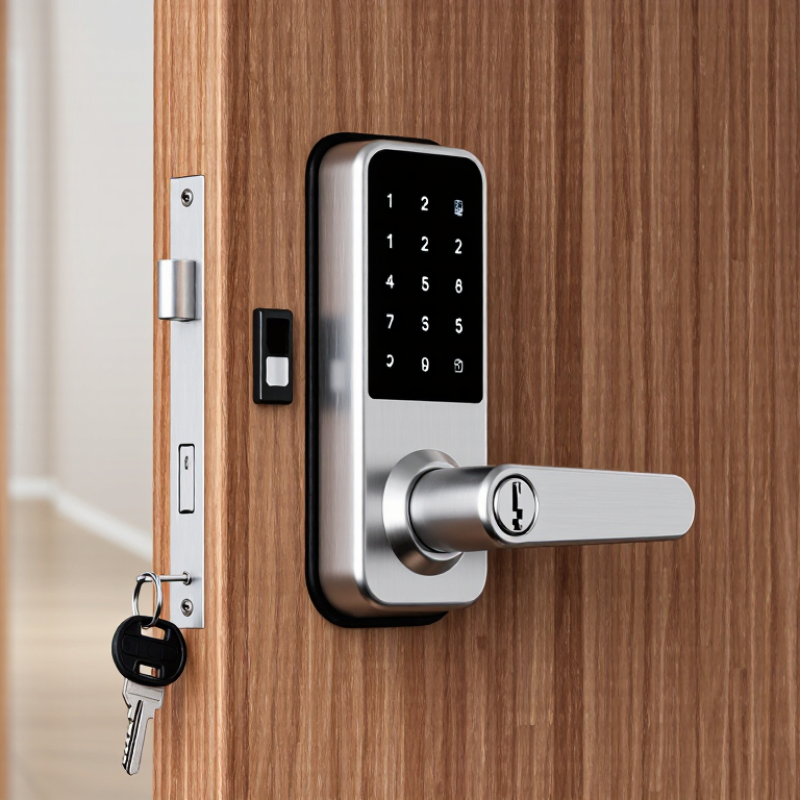
Table of Contents [Hide]
Identify Security Needs and Rental Property Requirements
Choosing a lock for a rental starts with the property, not the product. A ground-floor apartment with a glass patio door has different risks from an upper-floor studio. Walk around the property and inspect every entrance. Check for solid door frames, working deadbolts, and enough clearance for a replacement lock. Small gaps matter. Note who can currently enter, including tenants, cleaners, and maintenance workers.
Then consider how the home is used. Frequent tenant turnover may make rekeying or changing access codes practical, while a long-term rental may need a simpler setup. Ask who needs access and how often. Avoid relying on one permanent key shared among many people. Keep a record of access changes, but store it securely. A smart lock can be convenient, yet weak Wi-Fi, dead batteries, or confusing instructions can create new problems. Test its backup method before depending on it. Check that any planned changes fit the lease and local property requirements.
Set a budget that includes installation, replacement keys, batteries, and future access changes. In practice, a secure lock that takes too long to reset can frustrate both managers and tenants. I wouldn’t assume a keypad is automatically safer; that’s too simple. Consider whether residents can operate it easily, especially at night or in bad weather. A lock should suit the building’s actual entry points and the people who use them.
| Security Need or Property Requirement | Suitable Lock Type or Feature | Why It May Fit | Rental-Specific Checks | Limitations and Practical Notes |
|---|---|---|---|---|
| Secure the main entrance of a typical rental unit | Quality single-cylinder deadbolt paired with a compatible entry lock | A deadbolt extends a solid bolt into the door frame and is commonly used on residential exterior doors. | Check door and frame condition, bolt alignment, strike-plate attachment, and local requirements for safe egress. | A strong lock cannot compensate for a weak, damaged, or poorly fitted door and frame. |
| Change access between tenancies | Rekeyable cylinder or a lock designed for straightforward cylinder replacement | Rekeying changes which keys operate the existing cylinder, which can be more convenient than replacing the entire lock. | Plan a documented rekey or key-change procedure at each tenant turnover and maintain authorized access for emergencies. | Compatibility varies by lock and cylinder. Use a qualified locksmith when the lock is damaged, unfamiliar, or part of a restricted system. |
| Manage access for multiple units or staff | Professionally planned keyed system with tenant-specific keys and controlled staff access | A managed key system can simplify administration while limiting which doors each key can open. | Keep an up-to-date key register, restrict duplication where appropriate, and follow privacy, notice, and entry rules. | Master-key arrangements require careful key control; a master key can create broader access if lost or misused. |
| Offer keyless entry or easier guest turnover | Electronic keypad lock with individual, changeable access codes | Codes can be issued and changed without distributing a physical key for every access event. | Confirm that code management, tenant access, emergency entry, and any required records comply with local law and the lease. | Check battery status and the manufacturer’s emergency-access method. Do not assume every keypad lock has the same backup options. |
| Reduce unauthorized copying of physical keys | Restricted-keyway system managed by an authorized locksmith | Some systems limit key duplication to designated channels, supporting tighter control over additional copies. | Confirm who can authorize copies, how tenants receive keys, and what happens to keys at move-out. | Restricted duplication does not prevent a key from being lost, stolen, or copied unlawfully; retain a clear access-control process. |
| Protect a shared building entrance | Building-compatible access system selected with the property manager or association | Shared doors often need coordinated access control that works for residents, staff, visitors, and emergency services. | Review building rules, fire and egress requirements, accessibility needs, and responsibility for maintenance. | A unit owner or landlord may not be permitted to change a shared entrance lock independently. |
| Use a smart lock for remote code management | Smart lock with clear user permissions, supported updates, and a documented fallback method | Some models allow authorized users to manage access remotely and review lock activity. | Check tenant consent and privacy obligations, internet or hub requirements, account ownership, and how access transfers at turnover. | Features vary by model. Connectivity may fail, batteries need replacement, and activity logs can involve personal data. |
| Maintain safe emergency exit | Lock configuration that allows occupants to exit as required by applicable codes | Occupants need a reliable way to leave during an emergency; egress rules depend on the door, building, and jurisdiction. | Verify local building and fire codes before installing keyed-on-both-sides hardware or altering an existing egress door. | Do not assume a lock that works on one property is lawful or suitable for another. Seek local code guidance when uncertain. |
| Improve resistance to forced entry | Reinforced strike area, suitable fasteners, and a well-fitted deadbolt in addition to the lock itself | The door frame and hardware installation affect how well the complete entry assembly performs. | Inspect for loose hinges, frame damage, excessive gaps, and a strike plate that is not securely anchored. | Security depends on the whole door assembly, not just the lock’s appearance or advertised features. |
| Choose a practical option for a limited maintenance budget | Durable mechanical lock with readily available service and replacement parts | A mechanical lock avoids batteries and network service, which can simplify routine operation. | Compare installation, rekeying, key replacement, and maintenance costs over the expected service life. | Physical keys require secure handling and a turnover process; lower purchase price alone does not establish long-term value. |