
You have no items in your shopping cart.

What Is the Best Lightweight Down Sleeping Bag for 2026?
Choosing the best lightweight sleeping bag for 2026 is not simply a race to find the lowest weight. The right Light Down Sleeping Bag must balance warmth, packed size, durability, and comfort for your actual trips. A bag that feels impressively light in a shop may feel less appealing at 2 a.m., when cold air slips beneath the hood or damp socks share the footbox. Small details count.
Backpacking educator Andrew Skurka is often associated with the advice, “The best gear is the gear you don’t bring.” It is a useful reminder to assess every ounce, but warmth is not a place to cut blindly. This guide compares key choices, including down fill power, temperature ratings, shell fabrics, fit, and practical features such as draft collars and reliable zippers. It also considers the limits of product specifications: comfort ratings vary, and a number on a label cannot predict every sleeper’s experience. No bag is perfect.
Look for a model that suits your expected night temperatures, sleeping pad, and packing style—not just the lightest figure on a product page. We’ll weigh real-world trade-offs alongside published specifications, while noting where those details leave room for doubt. A few grams may matter on a long route. So can a warmer night.
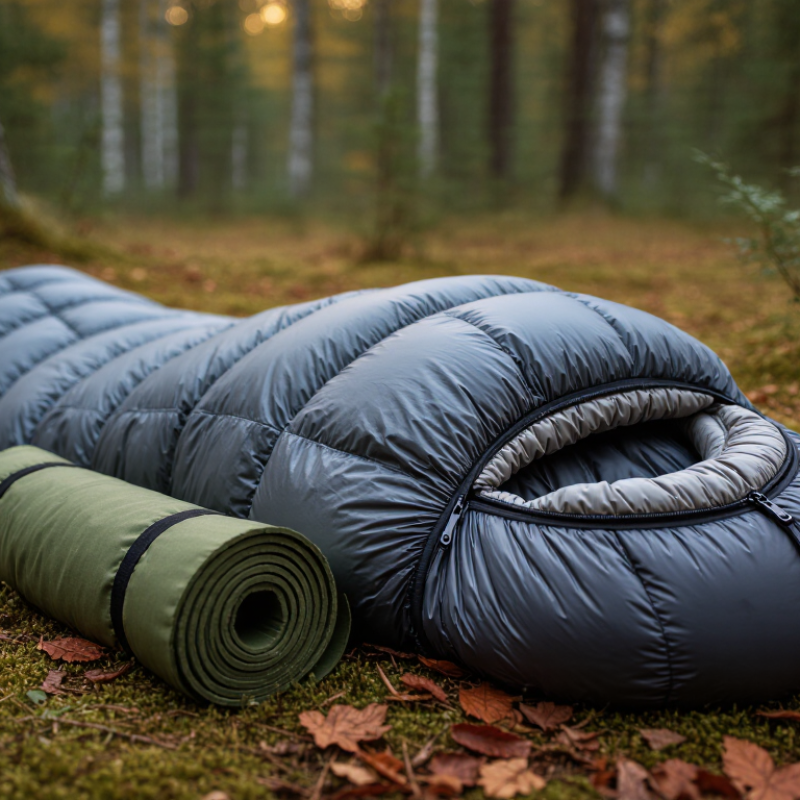
Table of Contents [Hide]
How Lightweight Down Sleeping Bags Are Designed
What Is the Best Lightweight Down Sleeping Bag for 2026?
How Lightweight Down Sleeping Bags Are Designed
A lightweight down sleeping bag is designed around a simple trade-off: retain warmth while reducing every unnecessary gram. Designers choose high-loft down, then place it inside narrow, sewn or baffled chambers. These chambers limit cold spots and keep insulation from sliding toward the edges. IDFL, an independent down-testing laboratory, explains fill power as the volume one ounce of down occupies under a defined test method. At 800 fill power, that volume is 800 cubic inches. Higher fill power can provide more loft per ounce, but it does not guarantee a warmer bag by itself. Cut, insulation quantity, and fit matter too.
The shell is usually a thin, tightly woven fabric that helps contain down without adding much weight. A contoured hood, insulated zipper guard, and shaped footbox reduce exposed gaps around the body. Thermal ratings need context: ISO 23537 sets laboratory methods for measuring sleeping-bag temperature performance, but real warmth also depends on clothing, ground insulation, and individual comfort. A neat rating cannot predict every chilly night. And the lightest design may feel cramped or less durable.
Tips: Compare comfort ratings, packed size, and total weight together. Check baffle construction and test conditions before choosing; small details matter.
What Is the Best Lightweight Down Sleeping Bag for 2026? — How Lightweight Down Sleeping Bags Are Designed
There is no single best bag for every sleeper. These brand-free profiles show practical design benchmarks; weights and fill amounts are approximate, not results for specific products. Choose by expected low temperature, fit, and the bag’s stated comfort rating.
| Design profile | Typical temperature target | Approx. total weight | Down and fill design | Construction choices | Best suited to |
|---|---|---|---|---|---|
| Ultralight summer | Around 35°F (2°C) | About 450–700 g (1.0–1.5 lb) | Often 800–900 fill power; relatively little down to limit packed weight | Narrow mummy shape, light shell fabric, and a short or simplified zipper | Warm-weather trips where low weight matters more than cold-weather range |
| Balanced three-season | Around 20°F (-7°C) | About 650–950 g (1.4–2.1 lb) | Often 800–900 fill power; enough loft and fill to balance warmth and weight | Shaped hood, draft collar, insulated zipper area, and baffles designed to reduce cold spots | A versatile choice for many backpacking trips in cool conditions |
| Cold-weather lightweight | Around 10°F (-12°C) | About 850–1,200 g (1.9–2.6 lb) | High-loft down can reduce the amount needed for a given warmth target, but substantial insulation is still required | More down, deeper baffles, a snug hood, and a well-sealed draft collar | Colder trips when dependable insulation takes priority over minimum packed weight |
| Roomier comfort fit | Often around 20–30°F (-7 to -1°C) | Typically heavier than a close-fitting equivalent | Fill amount depends on temperature target, dimensions, and insulation layout | More shoulder and hip room; may need extra insulation to warm the larger interior volume | Side sleepers and people who find narrow mummy bags restrictive |
How to compare: Fill power describes the loft produced by a given weight of down; it does not, by itself, determine a bag’s warmth. Construction, total insulation, fit, and temperature testing also matter. When comparing ratings, check whether they are comfort or lower-limit ratings under an EN/ISO test, and remember that a sleeping pad, clothing, and individual cold sensitivity affect real-world comfort.