You have no items in your shopping cart.

The word “best” sounds simple, but a Dog Launcher must suit dogs, handlers, and local buying conditions. In 2026, global buyers may face different product availability, shipping costs, replacement parts, and support options. A launcher that works well in a sunny backyard may feel awkward on wet grass or in a small park. Fit matters.
Animal-behavior expert Temple Grandin wrote, “Animals are not things, but they are not people either.” Her words are not about launchers, but they offer a useful reminder: comfort and supervision belong in any buying decision. That distinction matters. This guide compares launch distance, adjustable settings, ball compatibility, grip, cleaning, durability, and after-sales support. It also separates measurable features from claims that deserve closer checking.
Before buying, check return terms, replacement-ball sizes, charging details, and clear safety instructions. Small details matter. A longer throw is not automatically better, and some dogs may prefer hand-tossed play. That is worth admitting. We assess trade-offs rather than naming a universal winner, because dogs and play spaces vary. Use this comparison to shortlist options, then introduce a launcher cautiously in a familiar, open area. No launcher replaces attentive play.
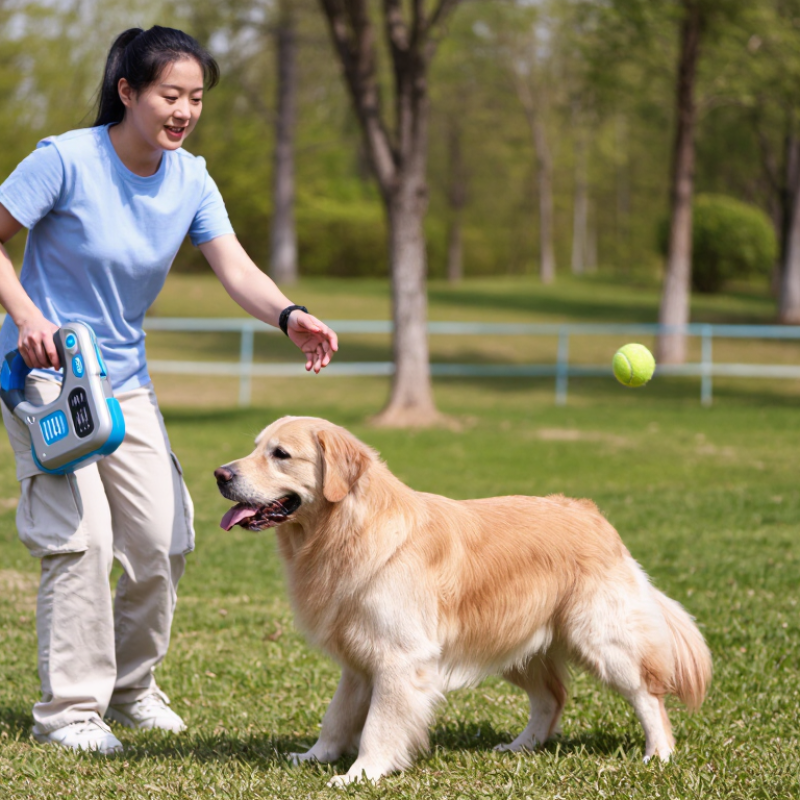
A dog launcher is a fetch device that sends a compatible ball across a yard or open field, reducing the repeated arm motion of throwing. Manual models use a lever or flexible arm. Automatic models typically use powered wheels or a spring mechanism to propel the ball. The basic loop is simple: load, launch, retrieve, repeat. Not every dog enjoys it.
The launch distance depends on the mechanism, ball size, and power setting. A wheel-based model may grip and accelerate a ball before releasing it; a manual launcher stores energy in its arm and releases it when the user swings. Sensors and adjustable settings appear on some automatic units, but they do not make supervision optional. Start with short throws in a clear space, check the ball for damage, and keep people away from the launch path. A wet or worn ball can behave unpredictably.
Market context matters for global buyers, but it is not proof of performance. The American Pet Products Association’s 2025 State of the Industry report estimated U.S. pet-industry spending at $152 billion in 2024, with $157 billion projected for 2025. That figure covers the wider pet sector, not dog launchers specifically. Compare launcher specifications carefully: supported ball diameter, power source, cleaning needs, and replacement-ball availability can vary by market. One detail is easy to overlook: a longer throw is not always better for a small yard—or a dog that tires quickly.
Dog launchers in 2026 generally fall into three practical types: handheld launchers, automatic ball launchers, and compact indoor models. A handheld launcher uses a long scoop or flexible arm to throw a compatible ball with less direct handling. It suits parks and open spaces, but the owner controls every throw. Check the ball size and grip before buying; a launcher that feels awkward in your hand may stay unused.
Automatic launchers eject balls at set or adjustable distances, giving active dogs repeated fetch sessions. Some models offer multiple distance settings or a rest timer, while others keep the controls simple. Look for clear safety instructions, stable placement, and easy-to-clean ball channels. Small details matter. These units need power, space, and supervision, and not every dog enjoys the sound or sudden movement. Indoor versions are often shorter-range and designed for smaller play areas, though “indoor” does not mean suitable for every room.
A third option is a compact launcher made for close-range play, including lightweight manual models and smaller automatic machines. It can work better in a yard or spacious room than a full-size outdoor unit. Buyers should compare dimensions, power requirements, replacement-ball availability, and setup instructions for their region. One type is not automatically best. I still find it easy to focus on throwing distance and overlook noise, storage, or whether a dog will actually retrieve the ball.
When comparing dog launchers, start with control over distance. A compact yard needs a different range from an open field. Look for clearly marked settings and a launch action that feels predictable, not abrupt. Begin at the shortest distance and watch how your dog responds. Keep play sessions supervised. A frightened dog may need a softer toy or a slower introduction.
Check the opening size, toy fit, and loading effort. A ball that jams or falls out can interrupt play, while an opening that is too large may not suit smaller dogs. The launcher should sit comfortably in the hand and remain stable during use. Easy-to-clean surfaces matter after wet grass or muddy paws. Small details count.
For international buyers, compare plug type, charging method, replacement-toy availability, and local service options before ordering. Battery claims can be hard to compare, so check what testing conditions the seller describes. I would not choose by maximum range alone; it can be impressive on paper and awkward in a small park. There is no perfect model. Read the instructions, inspect moving parts regularly, and choose settings that match your dog’s size, confidence, and play space.
| Feature | What to Compare | Why It Matters | Buyer Check |
|---|---|---|---|
| Launch distance and settings | Available distance settings and whether they can be adjusted | A shorter setting can suit smaller spaces; a longer setting needs more open space and supervision. | Check the manual for measured distance, surface conditions, and recommended clearance. Do not assume advertised maximum distance is suitable for every yard. |
| Ball compatibility | Required ball diameter, material, and whether alternative balls are permitted | A ball that is too large, too small, or unsuitable for the feed mechanism may not launch reliably and could create a safety risk. | Use the specified size and type. Confirm replacement-ball availability and avoid damaged or heavily worn balls. |
| Safety features | Motion or obstruction detection, launch warnings, and controls that prevent accidental activation | A launcher can propel a ball with force. Safe placement and keeping people and pets away from the opening are essential. | Read the safety instructions and check how the device behaves when a dog approaches the launch area. Sensors should not replace supervision. |
| Power and charging | Mains-powered, rechargeable, or battery-operated design; charging method; runtime information | Power options affect portability, operating cost, and convenience where an outlet is not nearby. | For international use, verify the input-voltage range and plug requirements on the product label or manual. Check whether an adapter is included and whether it is compatible with local power. |
| Indoor and outdoor suitability | Recommended operating location and any stated protection against moisture or dust | Not every launcher is designed to withstand rain, damp grass, dust, or outdoor storage. | Check the manual for environmental limits. Unless the manufacturer specifically permits it, keep the device dry and store it indoors. |
| Loading and play cadence | Manual or automatic loading, capacity, interval controls, and reset requirements | These determine how much interaction is needed and whether the play rhythm can be managed comfortably. | Look for clear instructions on loading and operating intervals. Give the dog breaks and stop play if it shows signs of fatigue or distress. |
| Noise and training support | Operating noise, audible launch cues, and whether the dog can learn to return a ball to the device | Noise sensitivity and training needs differ between dogs; a launcher does not teach safe play automatically. | Introduce the device gradually in a supervised setting. Check for sound demonstrations or user instructions before purchase. |
| Cleaning and maintenance | Access to the ball path, cleaning instructions, and availability of replacement parts | Dirt, hair, and worn balls can affect operation. Regular care helps keep the mechanism in usable condition. | Check whether cleaning requires tools and follow the manufacturer’s instructions. Disconnect power before cleaning when specified. |
| Shipping, warranty, and support | Delivery availability, return terms, warranty coverage, and service access in the destination country | Warranty and after-sales coverage can vary by seller and country; cross-border returns may involve extra cost or restrictions. | Confirm the destination is covered, identify who handles warranty claims, and review local import charges before ordering. |
Comparison note: There is no single best launcher for every dog or location. Prioritize ball compatibility, safe operation, suitable launch settings, and locally supported power and service; verify all specifications in the product manual before purchase.
For global buyers, safety starts with the dog, not the launcher. Choose a model suited to your dog’s size and strength, and use only the ball type specified by its maker. Check that the launch angle and distance can be adjusted; a small garden needs different settings from an open field. Keep people and other animals outside the launch path. Never let a dog retrieve a ball while the mechanism is active. Supervise every session. Even a sturdy device cannot prevent every accident, and that is easy to forget during play.
Durability matters when a launcher faces damp grass, dust, or frequent use. Look for a stable base, weather-resistant housing, and parts that are easy to clean or replace. After play, inspect the ball, feeding area, and moving parts for wear. Stop if anything cracks or sticks. Local rules also shape the choice: parks may restrict off-leash activity, powered devices, or noisy play, while shared spaces can have their own limits. Check current guidance from the relevant local authority before using a launcher outdoors. Rules vary, and online advice can be outdated. A practical choice leaves room for uncertainty: your dog may dislike the sound, or a quiet park may still be too crowded for safe practice.
A suitable dog launcher should match the dog, the play space, and the buyer’s market—not simply promise the longest throw. The American Pet Products Association’s 2025–2026 National Pet Owners Survey estimates that 68 million U.S. households own dogs. Its 2025 State of the Industry report puts U.S. pet spending at $152 billion in 2024. These figures show a large market, but they do not prove that any launcher is safe or effective. Check the ball size, adjustable distance, grip, and ease of cleaning. A small dog may struggle with oversized balls, while a powerful launch can be unsuitable in a short garden. Fit matters more than spectacle.
Consider the dog’s age, retrieving habits, and physical condition. A launcher with a modest, adjustable range may work better for an older dog or a narrow yard. Look for smooth edges, durable materials, and replacement balls that are easy to source locally. For global buyers, confirm voltage compatibility for powered models, spare-part availability, shipping costs, and clear care instructions. Test the device at a short distance in an open area, and supervise play. Not every dog enjoys the noise or motion. I would not assume a higher price means better reliability; that is an easy mistake. Ask about warranty terms and service response before ordering, especially when returns cross borders.
Start with ball compatibility and safe operation, then compare launch distance, power options, and ease of cleaning against your dog’s size, play style, and where you plan to use the launcher. Scores are a suggested buyer checklist, not survey results or product ratings; always follow the manufacturer’s instructions.