
You have no items in your shopping cart.

For international travelers, a translation mistake can turn a simple question into an awkward pause. Live Translation Earbuds promise a smoother exchange: one person speaks, a translated voice plays, and the conversation continues. The promise is useful. The experience can still lag.
Demand for accessible multilingual communication has a clear commercial signal. In its 2020 “Can’t Read, Won’t Buy” study, CSA Research surveyed 8,709 consumers across 29 countries; 76% said they preferred product information in their own language. That finding does not measure earbud sales. It does show why language access matters to global buyers. UNESCO also estimates that the world has more than 7,000 languages, a reminder that no single device can serve every conversation equally well.
Translation scholar David Bellos captured the deeper challenge: “Translation is not a matter of words only; it is a matter of making intelligible a whole culture.” For earbuds, that means more than converting words. Accent handling, background noise, response delay, and cultural nuance can shape whether a translation feels natural. A busy station is a tougher test than a quiet demo room.
China’s audio manufacturers offer global buyers a broad field of products to assess, from compact charging cases to app-connected interpretation modes. But specifications alone can mislead. Buyers should test supported language pairs, offline functions, privacy controls, and performance in real conversations. Small details matter. A half-second delay can interrupt a greeting. Even strong devices may miss an idiom. This guide compares the features and trade-offs that matter, while recognizing that live translation remains imperfect.
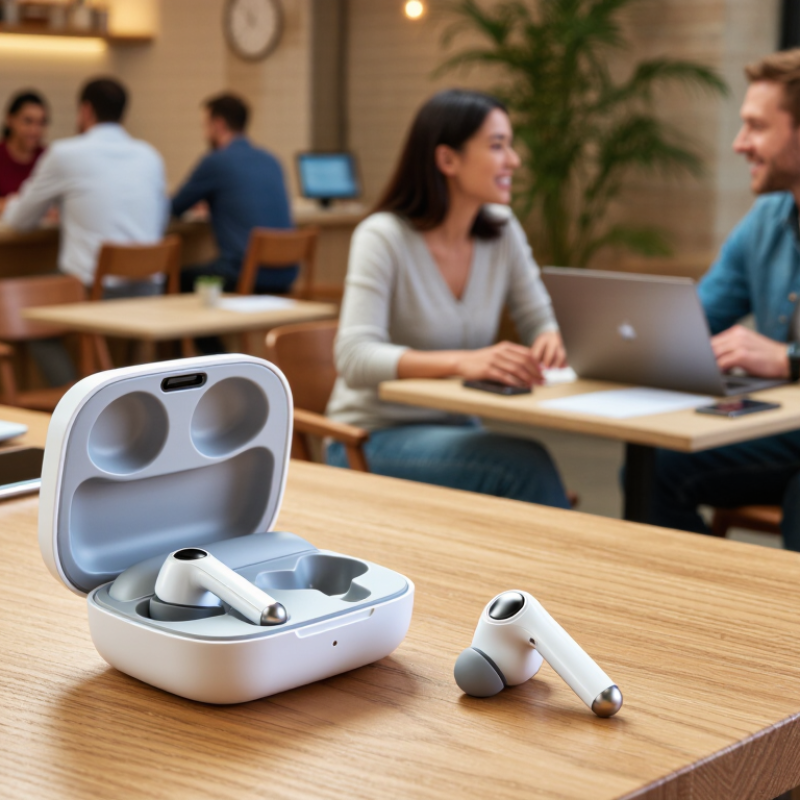
Live translation earbuds capture nearby speech through tiny microphones, then send the audio to speech-recognition software. The system turns spoken words into text, translates their meaning, and plays the result through the earbuds. Some models show translated text on a paired phone. Others let each person wear an earbud. That sounds simple. It isn’t. Accents, overlapping voices, and café noise can all distort the original sentence. A pause may help; a quiet room helps more.
Many earbuds rely on a phone and an internet connection, while some support selected offline language packs. Translation speed also matters: even a short delay can interrupt a conversation. Buyers should check supported language pairs, offline limits, microphone performance, and whether both speakers need a device. The need is real. CSA Research reported in its 2020 “Can’t Read, Won’t Buy” study that 76% of online shoppers preferred product information in their own language, while 40% would not buy from websites in other languages. Those figures describe online shopping, not earbud performance, but they show why language access matters. Machine translation still misses tone, idioms, and context. Treat it as a useful bridge, not a perfect interpreter.
For global buyers, useful live translation earbuds need more than a long language list. Check whether the advertised languages work in both directions and whether an internet connection is required. Some models offer offline translation for selected languages, but coverage may be limited. Microphone placement also matters. In a busy station, clear voice pickup can make a bigger difference than extra features. Small details matter.
Comfort, battery life, and connection stability deserve close attention. Translation may run through a phone app, so check phone compatibility and app requirements before buying. Ask how long the earbuds last during active translation, not only in standby. Review how voice recordings and conversation data are handled, too. Translation can miss names, accents, or jokes, and a delay may interrupt natural conversation. These tools work best for everyday exchanges, not as a substitute for careful listening. A short trial can reveal awkward controls or inaccurate phrases. That part is easy to overlook.
For live translation earbuds from China, language coverage matters less than how each language pair performs. Check whether the listed languages support two-way conversation, offline use, and regional accents. CSA Research’s 2020 survey of 8,709 consumers across 29 countries found that 76% prefer product information in their own language. That shows why language access matters, but it does not measure translation accuracy. Not the same thing.
Ask suppliers how accuracy is tested: quiet rooms can hide problems with accents, overlapping voices, and café noise. Try a real exchange, such as asking for directions while a fan runs nearby. Listen for missed numbers and names, not just fluent-sounding sentences. One weakness remains: broad language lists rarely explain dialect-level performance. A polished demo can still mislead.
Connectivity needs two checks. Bluetooth links the earbuds to a phone; cloud translation may also need a steady internet connection. Bluetooth SIG’s 2024 Market Update projected 7.5 billion annual Bluetooth device shipments by 2028, but ecosystem growth does not guarantee stable translation. Confirm compatible phone systems, app requirements, and offline language packs before buying. Then test reconnecting after walking out of range. Small detail, big difference.
Buyer comparison guide: translation features depend on the earbuds, companion app, phone, and service region. Language counts alone do not indicate translation quality.
| Buyer priority | Translation languages | Accuracy to expect | Connectivity and setup | Best fit and buyer check |
|---|---|---|---|---|
| Broad language coverage | Often delivered through a companion app; supported languages and language pairs vary by app and service. | Useful for clear, everyday speech. Results can worsen with accents, slang, overlapping speakers, or specialist terms. | Usually pairs with a smartphone over Bluetooth; cloud translation may also require internet access. | For frequent international travel. Check the exact source-to-target language pairs, not just the advertised language total. |
| Reliable use with limited internet | Offline translation is limited to languages supported by downloadable packs; availability differs across apps. | Offline results may differ from online results and may offer less coverage or fewer features. | Bluetooth connects the earbuds to the phone; download language packs and test offline operation before travel. | For flights or areas with weak service. Confirm which translation direction works offline and whether setup requires an account. |
| Two-way face-to-face conversation | Coverage depends on the app’s conversation mode and the languages selected by both speakers. | Turn-taking and clear speech help. Background noise and simultaneous speech can reduce recognition quality. | May use the phone microphone, earbud microphones, or both; supported modes vary by model and app. | For tourism and informal meetings. Check whether both speakers need earbuds or whether one phone can serve as the other speaker’s interface. |
| Calls and remote conversations | Call translation, where offered, may support fewer languages or work differently from in-person translation. | Call audio quality, network conditions, speaker clarity, and the translation service all affect results. | Check phone and app compatibility, Bluetooth call support, and whether call translation needs mobile data or Wi-Fi. | For work or family calls. Verify that translation works inside the intended calling app and in the buyer’s region. |
| Best overall buying approach | Prioritize the specific languages and regional variants needed; advertised totals may count dialects or features differently. | There is no single accuracy figure that predicts performance in every language, environment, and conversation. | Confirm supported phone operating systems, app availability, internet requirements, and Bluetooth pairing instructions. | Test the return policy, warranty coverage, charging plug, privacy settings, and app access in the destination market. |
Compare translation earbuds by task, not by the number of languages printed on the box. At a supplier meeting, prioritize clear microphone pickup, quick speaker switching, and reviewable transcripts. In a crowded exhibition hall, test speech recognition beside machinery or music. A quiet-room demo can flatter almost any model. It is not enough.
CSA Research’s 2020 report, Can’t Read, Won’t Buy, surveyed 8,709 consumers in 29 countries. It found 76% preferred product information in their own language, and 40% would not buy from websites in another language. These figures measure buying preferences, not earbud accuracy. Treat them as evidence for localization, not proof of live interpretation quality.
For travel, check offline language packs, simple setup, and battery life with translation active; standard playback claims may not reflect this workload. For remote calls, check app availability across regions. The ITU’s Facts and Figures 2023 estimated 5.4 billion people were online, leaving 2.6 billion offline; connectivity remains uneven, so offline support matters on some trips. Test your actual language pair, local accents, pauses, and overlapping speech with a stopwatch. Record missed phrases. Also note where the system guesses. That part is easy to overlook.
Global buyers should check how translation works in real conversations, not just product demonstrations. Ask which languages and dialects are supported, and whether translation requires an app or internet connection. A short delay can disrupt a quick exchange at a station or shop. Test with different speakers, accents, and background noise before placing a large order. The quiet-room demo may not tell the whole story.
Tips: Confirm phone compatibility, charging-port details, and app availability in your sales regions. Check battery life with translation active, not only during music playback. Request written warranty terms, spare-part availability, and a clear return process. Small details matter.
Review the microphone pickup and speaker fit, too. A loose earbud can make speech harder to catch, especially outdoors. Ask the supplier for test results and sample units, then compare them with your own use case. Also clarify how voice recordings are handled, stored, or deleted. Do not assume every model offers offline translation or identical features across languages. I would leave room for a second round of testing; one sample may not reveal every issue. For wholesale purchases, confirm packaging language and quality checks for each production batch.