
What Are the 2026 Top Industrial Panel Mount Monitors?

Choosing the 2026 top Industrial Panel Mount Monitors is not just a matter of screen size or price. A strong Industrial Panel Mount Monitor must stay readable under factory lighting, respond reliably to gloved hands, and fit the cutout already built into a control cabinet. Small details matter. A thick bezel, a poorly placed connector, or glare across the screen can slow an operator during a busy shift.

Industrial automation expert John Rinaldi is known for his work on industrial networks and automation. A practical paraphrase of the lesson his field emphasizes is: “An interface earns trust when its information remains clear and available.” This is not a verbatim quotation. It captures a useful test for any monitor: does it make machine status easy to see when the environment gets noisy, dusty, or hot?

This guide compares leading options by display brightness, touch technology, mounting dimensions, connectivity, operating temperature, and documented ingress protection. Check the exact model specifications; protection ratings may depend on the complete installation, not the display alone. Some machines need sunlight readability. Others need a compact screen beside a washdown area. There is no universal winner. Even a carefully selected monitor can disappoint if its touch surface conflicts with gloves or its ports are hard to reach. The shortlist should help buyers ask better questions, not replace testing against the actual cabinet, lighting, and workflow. A little uncertainty belongs here. Real factories rarely match a product datasheet perfectly.
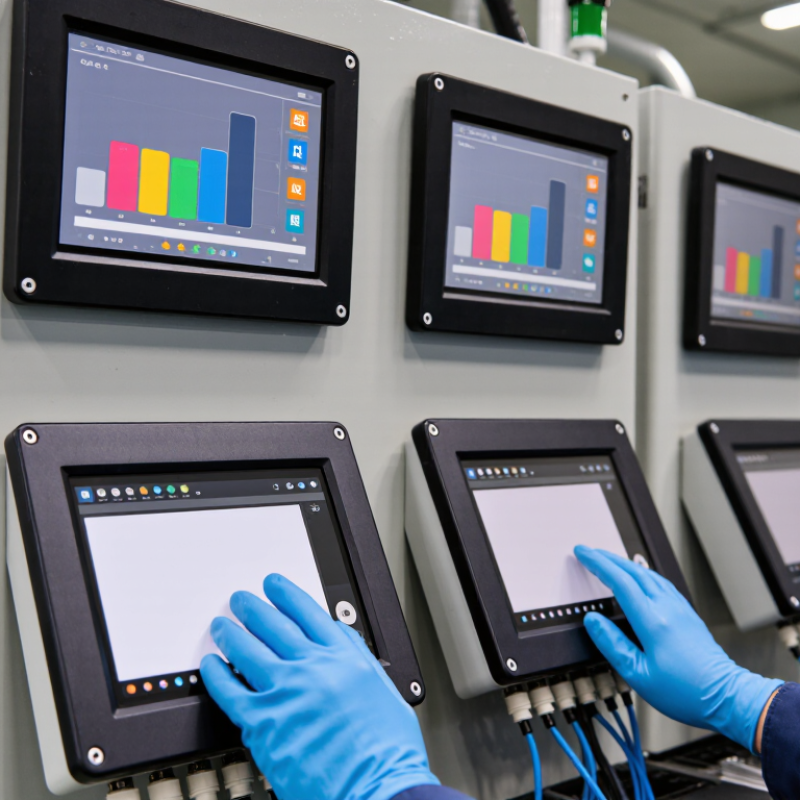
What Are the 2026 Top Industrial Panel Mount Monitors?

What Defines an Industrial Panel Mount Monitor?

What Are the 2026 Top Industrial Panel Mount Monitors?

What Defines an Industrial Panel Mount Monitor?

An industrial panel mount monitor is built to sit inside a machine cabinet or control panel, where space, heat, and dust can shape daily performance. Its front bezel fits a panel cutout, while rear-mounted electronics connect to controllers or computers. The screen should remain readable under factory lighting and respond reliably to gloved hands or repeated touch. Small details matter: a sealed edge, secure connectors, and a mounting system that does not loosen with vibration.

Durability is more than a rugged-looking case. IEC 60529 classifies enclosure protection; an IP65 front, for example, is dust-tight and resists water jets. That rating does not guarantee resistance to every chemical, cleaning method, or temperature. A spec sheet can still leave gaps. Check operating-temperature limits, brightness, touch technology, and whether the rear enclosure needs airflow.

The need for dependable operator interfaces is growing alongside factory automation. The International Federation of Robotics reported 4,281,585 industrial robots operating in factories worldwide in 2023, in its World Robotics 2024 report. That figure is not a monitor sales measure, but it shows the scale of equipment operators may need to supervise. In practice, the right display depends on its actual environment; a bright shop floor and a sealed washdown area call for different choices.

Which Features Matter Most in 2026 Models?

In 2026, the best industrial panel-mount monitor is the one that fits its actual environment. Brightness matters near windows or under factory lighting, but higher brightness can add heat and power demand. Check readability at the operator’s real viewing angle, not only in a product photo. Optical bonding can reduce reflections, though it may increase purchase and repair costs.

Touch performance needs a practical test. Can operators use the screen with work gloves? Does it respond reliably when droplets or dust are present? Small details matter. A front-face ingress rating, wide operating-temperature range, and resistance to vibration can be more useful than a long feature list. Confirm the rating applies to the installed front panel; the rear enclosure may need separate protection.

Plan for the connection and the years after installation. Match video inputs, mounting dimensions, and control-system requirements before ordering. A sharp display is not always the easiest to use; tiny interface elements can slow work on a compact screen. Check whether replacement units and technical documentation will remain available. And test the actual interface, if possible. Specifications rarely reveal every glare, glove, or layout problem. One overlooked point: a monitor that works perfectly in a lab may feel awkward beside a moving production line.

What Are the 2026 Top Industrial Panel Mount Monitors? - Which Features Matter Most in 2026 Models?

The entries below are application-oriented configuration profiles, not rankings of specific products. Specifications are representative selection ranges; actual capabilities vary by model and manufacturer.

Configuration profile Common screen size and resolution Touch options Typical brightness Front protection considerations Useful connections and mounting Best suited for
Compact control panel 10.1–12.1 in; commonly 1280 × 800 or 1280 × 1024 Resistive for gloved or stylus input; projected capacitive for multi-touch where supported About 250–500 cd/m² Choose a sealed front bezel and an ingress-protection rating appropriate to the cleaning and splash conditions HDMI or DisplayPort; USB for touch; panel cutout or VESA mounting, depending on design Machine control stations and space-constrained operator panels
General-purpose HMI 15–17 in; commonly 1024 × 768, 1280 × 1024, or 1366 × 768 Resistive or projected capacitive; select based on gloves, input method, and interface requirements About 250–500 cd/m² A flush, gasketed front can simplify wipe-down; verify the stated rating applies to the installed front face HDMI, DisplayPort, or VGA may be available; USB touch; panel or VESA mounting Production-line HMIs, process displays, and machine interfaces
Large-format operator display 19–21.5 in; commonly 1280 × 1024 or 1920 × 1080 Projected capacitive is common for direct multi-touch interaction; non-touch versions are also used About 250–500 cd/m² for many indoor applications Check bezel sealing, glass thickness, and impact requirements for the installation environment HDMI or DisplayPort; USB for touch; confirm cutout dimensions and VESA pattern Dashboards, supervisory control, and applications needing more on-screen information
High-brightness installation Typically 15–21.5 in; resolution depends on display size and application Touch optional; assess readability and touch performance under the actual lighting conditions Often 700 cd/m² or higher for high-brightness designs; confirm the specified value Consider optical bonding, anti-glare treatment, temperature range, and direct-sunlight limits where relevant Digital video inputs; verify power input, cooling needs, and mounting clearances Bright work areas, semi-outdoor locations, or installations with difficult ambient light
Legacy-system replacement Often 15–19 in; match the existing resolution and aspect ratio where software requires it Select resistive or non-touch when compatibility with existing workflows is important About 250–500 cd/m² for typical indoor use Compare bezel dimensions, cutout, connector position, and sealing before replacement VGA may be needed alongside newer video inputs; confirm signal timing and touch-driver compatibility Retrofits where existing cabinets, cabling, or control systems must be retained

Features that matter most in 2026: verify panel cutout and VESA compatibility, required resolution and video inputs, touch performance with the intended gloves, front-face sealing, brightness for ambient light, operating temperature, and long-term availability. Protection ratings and environmental suitability depend on the complete installed assembly, not just the monitor specification.

What Types of Industrial Panel Mount Monitors Are Available?

Industrial panel mount monitors come in several types, each suited to different work conditions. Resistive touchscreens respond to pressure from a gloved finger or stylus, making them practical near dust or in cold environments. Projected capacitive screens support familiar touch gestures and offer clear glass surfaces, but thick gloves may limit response. Some installations use non-touch displays with physical buttons or a separate keyboard. Simple can be reliable.

Other choices reflect the surrounding environment. High-brightness models improve visibility near windows or under strong factory lighting, while sealed, fanless monitors can reduce openings where dust and moisture enter. Open-frame versions fit custom enclosures, and wide-temperature models suit areas with large temperature swings. These features involve trade-offs: brighter screens can draw more power, and sealing can make servicing less convenient. There is no perfect combination; actual site conditions matter more than a feature list.

Tips: Check the panel cutout, viewing angle, touch method, and cable access before choosing. Test the screen with the gloves operators actually wear. Also consider cleaning routines and ambient light. A monitor that looks suitable on a specification sheet may feel awkward at the workstation, so a short on-site trial can reveal issues early.

How Do Leading 2026 Monitors Compare?

What Are the 2026 Top Industrial Panel Mount Monitors?
How Do Leading 2026 Monitors Compare?

The strongest 2026 options are best compared by application, not by a single “top” ranking. A production-line operator may value a bright, readable screen, while a washdown area demands a sealed front and carefully specified ingress protection. Compare native resolution, viewing angles, touch response, and rated operating temperature. Check the full specifications; similar-looking displays can behave differently under glare or with work gloves.

Tips: Confirm cutout dimensions before ordering. Check twice. Verify the connector type, cable clearance, and mounting depth against the actual cabinet. A monitor that fits the opening may still leave too little space behind it.

For continuous use, review the stated duty cycle, cooling method, and warranty terms. Fanless designs can reduce moving parts, but they may need more careful thermal planning inside a warm enclosure. Resist choosing by brightness alone: a very bright panel can create unnecessary heat or cost if the display sits indoors. Where possible, test touch accuracy with the gloves operators actually wear. One detail is easy to miss: sunlight readability and wide viewing angles are not interchangeable. Compare documented ratings and sample units under the real lighting and temperature conditions; product specifications do not always reveal every installation challenge.

How to Choose a Monitor for an Industrial Application?

What Are the 2026 Top Industrial Panel Mount Monitors?

How to Choose a Monitor for an Industrial Application?

Choose a monitor around the conditions at its mounting point, not just its screen size. Check the cabinet opening, mounting depth, cable clearance, and viewing distance before comparing models. A bright screen can help near a sunlit loading bay, while a sealed front may matter more beside washdown equipment. Dust, vibration, heat, and cleaning chemicals all affect service life. Ask for operating-temperature and ingress-protection details, then compare them with the actual site conditions. Ratings are useful, but installation quality matters too.

Match the display’s touch technology to the task. Gloved operators may need resistive touch or a glove-capable projected capacitive screen; test it with the gloves they actually wear. Check resolution, brightness, viewing angles, and whether reflections obscure alarms from the operator’s usual position. Confirm that the video inputs match the control system, and allow room for connectors and strain relief. It is easy to overlook those small details. Also consider replacement availability, mounting standards, and how the screen can be cleaned without pressing unwanted controls. A quick trial on the production floor can expose glare, awkward reach, or missed touches. No specification sheet catches everything. Allow for that.